


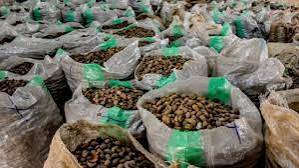
President Bola Tinubu has approved a six-month temporary ban on the export of raw shea nuts to strengthen local processing, curb informal trade, and improve Nigeria’s share in the multi-billion-dollar global shea industry.
Vice President Kashim Shettima announced the directive at a multi-stakeholder meeting on Tuesday at the State House, Abuja. He said the policy, effective immediately and subject to review after expiration, is expected to generate at least $300 million annually in the short term.
“This is not an anti-trade policy but a pro-value addition policy designed to secure raw materials for our processing factories and enable industries to run at full capacity,” Shettima said. “It will transform Nigeria from an exporter of raw shea nuts to a global supplier of refined shea butter, oil, and other derivatives.”
He added that Nigeria, despite producing nearly 40 per cent of the world’s shea, currently accounts for only one per cent of the $6.5 billion global market. The government projects a tenfold increase in revenue by 2027.
Minister of Agriculture and Food Security, Senator Abubakar Kyari, said a rapid assessment of the shea value chain revealed that more than 90,000 metric tonnes of raw shea are lost annually to informal cross-border trade, while domestic processors operate at less than half of their 160,000 metric tonnes capacity.
Kyari noted that neighbouring countries such as Ghana, Burkina Faso, Mali, and Togo had already imposed restrictions to protect their industries, leaving Nigeria vulnerable to unregulated buying.
He stressed that Nigeria, with over five million hectares of wild shea trees, holds both a comparative and absolute advantage in the sector. “Ninety per cent of pickers and processors of shea are women. Investment in this value chain directly translates into women’s empowerment, rural job creation, and sustainable livelihoods,” Kyari said.
The government said the measure aligns with its industrialisation and empowerment agenda and would position Nigeria to capture a significant share of the projected $9 billion global shea market by 2030.