

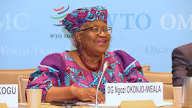
The Director-General of the World Trade Organization (WTO), Dr. Ngozi Okonjo-Iweala, has expressed concern over the growing trade tensions between the United States and China, warning that a further escalation could severely impact global economic stability.
Speaking in an interview with Reuters over the weekend, Okonjo-Iweala said prolonged trade disputes between the world’s two largest economies could cut global economic output by as much as seven percent in the long term.
Her remarks come after the WTO revised its 2026 global merchandise trade volume growth forecast downward to 0.5 percent, from the earlier projection of 1.8 percent in August, citing the delayed effects of U.S. President Donald Trump’s new tariffs on Chinese goods. The organization, however, raised its 2025 growth outlook to 2.4 percent.
The renewed tensions followed China’s decision to impose new export restrictions on rare earth metals used in the technology industry, prompting the U.S. to announce 100 percent tariffs on Chinese imports starting next month.
“We’re obviously worried about any escalation in U.S.-China tensions,” Okonjo-Iweala said. “We hope both sides will de-escalate because such conflicts have implications not only for the two biggest economies but also for the rest of the world.”
She cautioned that any economic decoupling between the two countries could split the global economy into rival blocs, resulting in “up to seven percent losses in global GDP” and “double-digit welfare losses for developing countries.”
Addressing G20 officials last week, Okonjo-Iweala stressed that “there can be no global financial stability without global trade stability,” warning that the effects of recent tariffs were still unfolding and could intensify protectionist sentiment elsewhere.
Despite ongoing trade disputes, she noted that 72 percent of global trade remains governed by WTO rules, underscoring the resilience of the multilateral trading system. She, however, called for reforms to make the WTO more adaptable to emerging trade opportunities in digital services, green industries, and modern commerce.
“There’s absolutely no doubt that global challenges require collective solutions,” she said. “Multilateralism remains relevant, but to strengthen trust and effectiveness, institutions like the WTO must reform—and we are ready to do so.”
Okonjo-Iweala also disclosed that she recently met with U.S. Deputy Trade Representative Joseph Barloon, who was newly confirmed as U.S. Ambassador to the WTO. She welcomed Washington’s decision to remove the WTO from its list of proposed international spending cuts and confirmed that efforts were ongoing to settle U.S. financial arrears to the organization.