

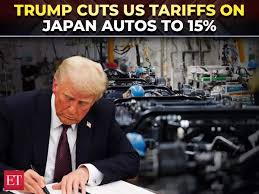
US President Donald Trump on Thursday signed an executive order reducing tariffs on Japanese car imports from 27.5 per cent to 15 per cent, a move expected to ease pressure on global auto giants including Toyota, Honda, and Nissan.
The order formalises a trade agreement first announced in July, under which most Japanese exports to the US, including vehicles and pharmaceuticals, will now face a 15 per cent levy. In exchange, Japan has pledged to invest $550 billion in US projects and expand access for American goods, particularly cars and rice.
According to the White House, Tokyo has committed to purchasing $8 billion worth of US goods annually, ranging from agricultural produce to fertilisers and bioethanol. It will also increase imports of US-grown rice by 75 per cent, marking a major concession in its traditionally protected agricultural sector.
Trump hailed the agreement as a “great deal for everybody,” while Japan’s chief trade negotiator, Ryosei Akazawa, responded to the announcement with a single-word post: “Finally.”
Automobiles remain central to Japan’s economy, making up about 20 per cent of total exports, with the US as its largest market. Toyota had recently warned that Washington’s previous tariff regime could cost it $10 billion this year.
The agreement, reached after months of negotiations following Trump’s tariff hikes in April, highlights the strategic importance of the US-Japan trade relationship amid global market uncertainty.