

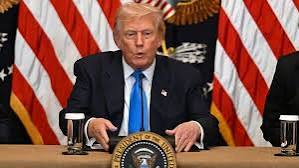
United States President Donald Trump has signed a sweeping executive order imposing a 15 percent tariff on Nigeria and several other African countries, sparking widespread concerns over trade disruptions and economic fallout across the continent.
The new tariff regime, announced by the White House on Thursday, is part of a broader recalibration of U.S. trade policy that affects more than 60 countries. Tariff rates under the order range from 10 to 50 percent, with African economies among the hardest hit. The move has triggered global uncertainty, raised fears of job losses, and rattled markets.
Citigroup’s Head of Sub-Saharan Africa, Akin Dawodu, warned that the new tariffs could accelerate Africa’s pivot toward alternative trade partners, particularly China, the European Union, and Middle Eastern economies.
In an interview with Bloomberg, Dawodu said: “The U.S. decision to impose tariffs of up to 30 percent on imports from countries like South Africa, Algeria, Nigeria, and Ghana may further weaken Africa’s already limited trade relationship with the U.S.”
The Nigerian currency, the naira, saw marginal depreciation in the official foreign exchange market following the announcement, closing at N1,555 to the dollar compared to N1,550 the previous day. However, in the parallel segment of the market, the exchange rate held steady at N1,533 to the dollar.
Despite the tariff shock, the Nigerian stock market remained resilient. The All Share Index of the Nigerian Exchange Group (NGX) rose by 1 percent to close at 141,263.05, while market capitalization increased to N89.373 trillion from N88.425 trillion. Trading volume reached 1.08 billion units valued at N26.85 billion in 34,488 deals, though market breadth was negative with 34 gainers and 35 losers.
The U.S. had initially imposed a 14 percent tariff on Nigeria in April as part of a broader protectionist push, but implementation was delayed for 90 days to allow for bilateral negotiations. Those talks failed to yield any new agreements, prompting the inclusion of Nigeria and several others in the revised tariff schedule. The updated tariffs are now set to take effect on August 7.
Trump has defended the new measures as “reciprocal” and aimed at leveling the playing field for U.S. exporters. However, trade analysts say the policy may undermine U.S. relations with key partners and raise domestic inflation concerns, as reported by UK-based The Guardian.
No African country successfully concluded a new trade deal with the U.S. during the negotiation window, despite high-level diplomatic efforts. Nigeria, initially excluded from the tariff list, was later added as the policy expanded.
Dawodu emphasized that Africa must look inward and strengthen intra-African trade to reduce dependence on traditional partners. He pointed to the African Continental Free Trade Area (AfCFTA) as a key platform for economic resilience.
“AfCFTA could raise Africa’s share of global exports to 4.4 percent by 2043, up from the current 3.5 percent,” Dawodu noted. “The continent’s growth will be increasingly driven by its young population and rising consumer class—key fundamentals that can weather short-term shocks like U.S. tariffs.”
He also urged African governments to remove non-tariff barriers, such as legal inconsistencies, logistics challenges, and labor mobility restrictions, which continue to hinder regional integration and competitiveness.
With Africa holding 60 percent of the world’s remaining arable land and a third of its mineral reserves, Dawodu concluded that the continent remains critical to the future of advanced industries, including those tied to artificial intelligence and global supply chains.