

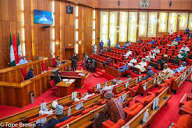
The Senate has suspended further consideration of the Electoral Act Amendment Bill, 2025, after a heated debate revealed deep divisions among lawmakers over the proposed changes.
Senate President Godswill Akpabio halted deliberations on Thursday, citing a lack of clarity in the amendment proposals and using the opportunity to recall what he described as the “grave injustice” he suffered during the 2019 general election.
The session had begun with the Chairman of the Senate Committee on Electoral Matters, Senator Simon Lalong (Plateau South), leading the debate on the general principles of the bill. However, proceedings turned contentious when Senator Titus Zam (Benue North East) urged that the bill be passed for second reading, prompting Akpabio to demand specific details of the sections of the 2022 Electoral Act slated for amendment.
Akpabio insisted that the Committee provide “the nitty-gritty” of the proposed reforms before any further consideration, stressing that the Senate must fully understand the implications of the changes being introduced.
In a personal reflection, Akpabio recounted his 2019 senatorial election experience, claiming he was unfairly treated despite clear legal provisions. He criticised the Independent National Electoral Commission (INEC) for what he termed “selective justice,” citing the conviction of Professor Peter Ogban, the returning officer during the election.
“The court ordered that those who committed the offence be prosecuted, yet INEC went after the wrong person. If the returning officer was helping me, how come my votes were the ones affected?” he queried.
The Senate President also faulted Nigeria’s extended election timelines, arguing that prolonged campaigns and transitions hinder effective governance.
“Campaigns drag on for months, followed by long pre-election processes. When elected officials later assume ministerial positions, it disrupts governance and national development. We must strike a balance between electoral timelines and administrative efficiency,” he stated.
Following the debate, Senate Leader Opeyemi Bamidele moved a motion to stand down the bill, allowing the Committee on Electoral Matters more time to clarify the proposed amendments. The motion was unanimously adopted.