

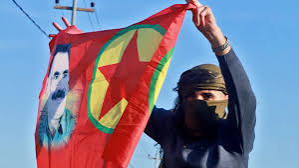
In a landmark development that could signal the end of one of the longest-running armed struggles in the Middle East, the outlawed Kurdistan Workers’ Party (PKK) has begun disarming after nearly 40 years of conflict with the Turkish state.
At a symbolic ceremony near Jasana Cave—located about 50km northwest of Suleymaniyah in Iraq’s Kurdistan region—roughly 30 PKK fighters, including four senior commanders, placed their weapons into a large cauldron and set them ablaze. The moment, described as the “first step” in a phased disarmament process expected to last through the summer, was witnessed by journalists, Kurdish politicians, and members of Turkey’s pro-Kurdish DEM party.
“We voluntarily destroy our weapons before your presence, as a gesture of goodwill and resolve,” the fighters said in a joint statement. “This is a historic, democratic step.”
Turkish President Recep Tayyip Erdoğan hailed the event as “an important step towards our goal of a terror-free Turkey,” signaling official support for what many hope will be a decisive end to the decades-long conflict that has claimed more than 40,000 lives since the PKK launched its armed campaign in 1984.
The PKK, which initially sought Kurdish independence and later shifted its demands to greater autonomy and cultural rights, is designated as a terrorist organization by Turkey, the United States, the European Union, and the United Kingdom.
At the heart of the disarmament initiative is PKK founder Abdullah Ocalan, who has been held in solitary confinement on Turkey’s Imrali Island since 1999. Earlier this week, Ocalan issued a public statement calling for “a voluntary transition from the phase of armed conflict to the phase of democratic politics and law.”
In a rare video appearance—the first in over 20 years—Ocalan urged PKK members to embrace political dialogue. “I believe in the power of politics and social peace, not weapons,” he said, wearing a beige Lacoste polo shirt in a clip that quickly went viral among Kurdish communities worldwide. He reiterated his stance in a letter delivered in February by DEM lawmakers, stating: “All groups must lay down arms and the PKK must dissolve itself.”
This latest peace initiative has roots in developments from October 2024, when Devlet Bahçeli, a key nationalist ally of Erdoğan, publicly endorsed a vision of a “terror-free Turkey” and encouraged dialogue with Ocalan. Talks resumed through pro-Kurdish intermediaries, and in April 2025, Erdoğan met with Kurdish politicians for the first time in years, calling the moment “an opportunity to tear down the wall of terror.”
While previous peace efforts—including a 2013 ceasefire and the 2015 Dolmabahçe Agreement—ultimately collapsed and led to renewed fighting, this latest initiative is seen by many observers as more serious and structured.
“This is the strongest chance yet for a sustainable peace,” said a senior Turkish official involved in the ongoing talks. “The PKK says its historic mission is complete. That opens a door—but the success of this transition depends entirely on replacing military engagement with a durable political process.”
The disarmament of the PKK has wide-reaching implications beyond Turkey’s borders. With its networks active in Iraq, Syria, and Iran, a full demobilization could reshape the region’s security landscape and pave the way for deeper political inclusion of Kurdish groups.
Yet many challenges remain. Turkey’s parliament is expected to set up a special commission to determine next steps, but with summer recess approaching, concrete legislative progress is unlikely before autumn. The future of Ocalan also remains uncertain—while officials suggest his prison conditions could be eased, any talk of release has been firmly ruled out for now.
Still, Ocalan remains a powerful symbolic figure. “He is a central icon for many Kurds, though not all,” said Joost Jongerden, a scholar on the Kurdish conflict at Wageningen University in the Netherlands. “His authority remains significant.”
As hopes for a lasting peace grow, caution lingers among many Kurds and Turkish citizens alike. But after decades of war, the PKK’s decision to disarm marks what many are calling the most hopeful moment in a generation.