


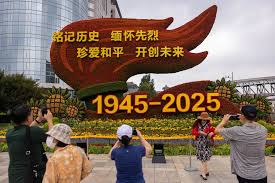
China will stage a large-scale military parade in Beijing on September 3 to commemorate 80 years since the end of World War II, officials announced on Wednesday.
The event, to be held at Tiananmen Square, will mark Japan’s 1945 surrender and showcase China’s expanding military power amid rising regional tensions.
According to organisers, the 70-minute “Victory Day” parade will include 45 troop formations, hundreds of aircraft, and advanced ground equipment—some of which will be displayed publicly for the first time. Expected highlights include hypersonic-capable missiles, anti-ship weapons, air defence systems, and anti-drone technology.
“The weapons and equipment will fully demonstrate our military’s robust ability to adapt to technological advancements, evolving warfare patterns, and win future wars,” said Wu Zeke, deputy director of the parade committee.
President Xi Jinping will preside over the ceremony, joined by senior Communist Party leaders and invited foreign dignitaries. Russian President Vladimir Putin is expected to attend, continuing Moscow’s close alignment with Beijing.
The parade will be only the second of its kind since 2015, when more than 12,000 soldiers and several foreign contingents marched through Beijing with over 500 pieces of equipment and 200 aircraft. This year’s display is expected to equal or surpass that scale, analysts say.
Authorities have tightened security in the capital ahead of the event, with road closures, checkpoints, and temporary shutdowns of shopping centres and office buildings near Tiananmen Square. Large rehearsals earlier this month drew tens of thousands of participants.
While the parade formally commemorates the Allied victory over Japan, security experts note it also serves as a political signal. Observers say Beijing aims to demonstrate both to its citizens and the international community that the People’s Liberation Army is not only modernising but preparing to defend China’s interests in contested areas such as the South China Sea and Taiwan Strait.