

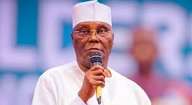
Former Vice President Atiku Abubakar has formally joined the African Democratic Congress (ADC), marking his sixth party affiliation in 38 years and positioning himself for another presidential run ahead of the 2027 general elections.
Atiku registered as an ADC member at his Jada 1 Ward in Adamawa State on Monday, 130 days after leaving the Peoples Democratic Party (PDP), under which he contested the presidency twice. The former vice president, who turned 79 on November 25, will be 81 in 2027, prompting renewed debate about his political prospects.
Describing his move as part of a “decisive national rescue mission,” Atiku said the country was facing a severe leadership crisis under the All Progressives Congress (APC). He said his entry into the ADC signaled the start of a strategic realignment aimed at unseating the ruling party, urging Nigerians to rise above ethnic and religious divisions and support efforts to restore stability and good governance.
APC’s Oshiomhole Knocks Atiku’s Credibility
Reacting to Atiku’s move, former APC National Chairman Senator Adams Oshiomhole said the ex–vice president lacked the capacity to lead the country, arguing that he failed to reform or strengthen the PDP when he had the chance.
“If Atiku, as a former vice president, could not fix the PDP, how can he claim he will fix Nigeria?” Oshiomhole said on Channels Television.
Atiku Counters: APC’s Failures Cannot Be Hidden
Atiku’s camp dismissed Oshiomhole’s remarks as an attempt to divert attention from the APC’s failures. In a statement, Atiku’s Senior Special Assistant on Public Communication, Phrank Shaibu, said Oshiomhole lacked the moral standing to question Atiku’s leadership.
Shaibu accused the former APC chairman of trying to mask the party’s “monumental failures,” saying Atiku operated within democratic structures in the PDP and never ran a party like a personal empire.
A Long Political Journey
Atiku’s political career dates back to the late 1980s when he served as National Vice-Chairman of the People’s Front of Nigeria (PFN). He contested the 1992 SDP presidential primaries but stepped down for Chief MKO Abiola.
He played a key role in the formation of the PDP and won the Adamawa governorship in 1998 before being selected as Olusegun Obasanjo’s running mate. As vice president between 1999 and 2007, Atiku oversaw major privatization reforms but later fell out with Obasanjo over political differences, leading to his first defection in 2006 to the Action Congress (AC), under which he contested the 2007 election.
Atiku returned to the PDP in 2009, sought the party’s presidential ticket in 2011, and defected again in 2014 to join the APC, where he lost the presidential primaries to Muhammadu Buhari. He returned to the PDP before the 2019 and 2023 elections, emerging as its presidential candidate on both occasions.
His July 2025 resignation marked the third time he left the PDP, this time joining an opposition coalition anchored on the ADC.
2027: A Final Attempt?
With five previous party switches since 1999 and multiple presidential attempts, Atiku’s newest move is widely seen as another effort to shape Nigeria’s political future. Whether his latest alignment with the ADC will help him achieve his long-standing ambition of leading the country remains to be seen.