


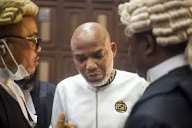
The Court of Appeal in Abuja on Friday struck out an appeal filed by Nnamdi Kanu, the convicted leader of the Indigenous People of Biafra (IPOB), challenging alleged violations of his fundamental rights by the Federal Government.
In a unanimous decision, a three-member panel held that the case had become academic since Kanu had already been convicted and is currently serving his sentence at the Sokoto Correctional Centre. Justice Boloukuromo Ugo, who delivered the lead judgment, noted that Kanu’s request to be moved from the custody of the Department of State Services (DSS) to Kuje prison was no longer relevant.
The court further ruled that with Kanu now held in a correctional facility—his previously stated preference—the appeal lacked merit and was accordingly struck out.
Kanu had appealed the July 3 judgment of Justice Taiwo Taiwo of the Federal High Court, which dismissed his suit seeking enforcement of his fundamental rights. In the suit, he accused the DSS of repeatedly denying him access to his lawyers and doctor, preventing him from changing clothes, and restricting him from practicing his religion, contrary to court orders.
His lawyer, Maxwell Opara, also alleged that DSS medical personnel took his client’s blood samples multiple times without providing medical reports, and urged the court to summon the DSS Director-General for clarification.
However, counsel to the DSS, I. Awo, urged the court to dismiss the application, arguing that Kanu failed to prove that DSS doctors were unqualified. He further maintained that no court order granted the IPOB leader unrestricted access to a physician of his choice.
The Attorney General of the Federation, represented by Simon Enoch, also opposed the appeal.
Kanu’s dismissed requests included access to an independent medical practitioner, unrestricted consultations with his doctor and lawyer, removal from solitary confinement, and an injunction restraining the DSS from further alleged rights violations.
On November 20, the Federal High Court convicted Kanu on seven counts of terrorism and related offences. Justice James Omotosho ruled that the prosecution proved its case beyond reasonable doubt and sentenced him to life imprisonment.