


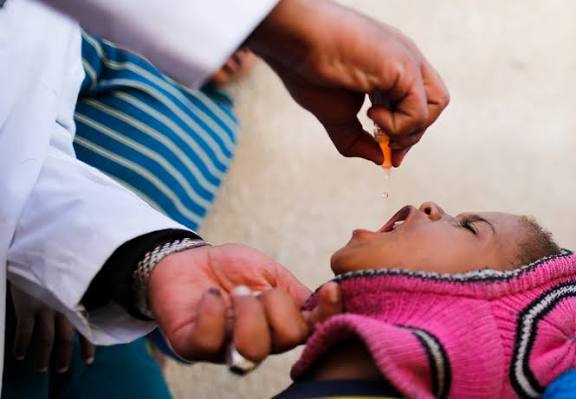
The World Health Organisation (WHO) has announced significant progress in the fight against polio in Africa, revealing that the number of countries with active type 2 poliovirus outbreaks declined from 24 in 2024 to 14 in 2025. The organisation also reported a 54 percent drop in total virus detections as of October this year.
WHO Regional Director for Africa, Dr. Mohamed Janabi, disclosed this in a message to mark World Polio Day 2025, with the theme “End Polio: Every Child, Every Vaccine, Everywhere.” He said the continent is making steady progress towards achieving a polio-free Africa, emphasizing the need to ensure that no child is left unprotected.
“The progress in 2025 reflects stronger cross-border coordination, expanded surveillance, improved laboratory capacity, and the use of digital tools to increase reach, efficiency, and equity,” Janabi stated.
According to the WHO, between January and October 2025, about 200 million children in 15 African countries received at least one dose of the polio vaccine through supplementary immunisation rounds. Thirteen countries conducted synchronised campaigns, even in difficult environments.
In the Horn of Africa, Djibouti, Ethiopia, Kenya, and Somalia jointly vaccinated over 18 million children in two consecutive rounds, demonstrating the effectiveness of regional collaboration. WHO also highlighted the importance of cross-border coordination in reaching children in hard-to-reach areas such as the Lake Chad Basin and Sahel.
In April 2025, Ministers of Health across the sub-region launched a coordinated campaign to protect 83 million children, while Madagascar officially declared the end of its circulating variant poliovirus type 1 outbreak in May 2025 following sustained response measures and surveillance.
The organisation noted that Africa’s progress is being supported by stronger health systems. By mid-2025, 11 WHO-supported laboratories had expanded genomic sequencing capacity, and six others began piloting advanced techniques. Environmental surveillance also expanded, with 98 percent of countries in the WHO African Region now monitoring wastewater and sewage for polioviruses to detect early signs of transmission.
Additionally, geospatial mapping by the WHO AFRO GIS Centre has enabled countries to locate and vaccinate children in previously missed populations, including nomadic and border communities.
WHO further reported that over 850,000 frontline workers across the region now receive digital payments through mobile-money platforms, with 95 percent paid within ten days of campaign completion a development that has improved accountability and timeliness, especially in remote areas.
“As we celebrate Africa’s progress towards a continent free of polio, we renew our collective commitment to protecting every child from this preventable disease,” WHO stated.