

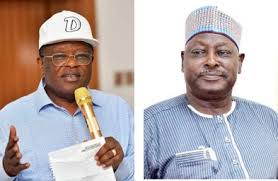
The Minister of Works, David Umahi, has criticised former Secretary to the Government of the Federation (SGF), Babachir Lawal, over his recent remarks describing the Lagos-Calabar Coastal Highway project as a scam.
In a statement issued on Monday in Abuja by his spokesperson, Uchenna Orji, the minister described Lawal’s comments as “desperate and hypocritical,” accusing him of failing to appreciate the infrastructural strides of President Bola Tinubu’s administration.
“It is unthinkable for a man of his standing to ignore the bold achievements of the Renewed Hope administration, particularly in road infrastructure development,” Umahi said.
He said Lawal’s criticism of the project, including the commissioning of its first phase, shows a lack of understanding of project execution, especially the concept of phasing. According to the minister, project phasing involves dividing large-scale projects into manageable segments to enable effective planning, resource allocation, and progress tracking.
Umahi explained that the Lagos-Calabar Coastal Highway is being developed in phases due to its massive scope and funding requirements. He noted that the initial section already commissioned has provided critical insights into the project’s complexity, productivity, and timelines.
The minister further defended the administration’s infrastructure agenda, stating that all inherited projects across Nigeria’s six geopolitical zones are ongoing, with improvements in delivery speed, quality, and value for money. He added that President Tinubu has initiated four legacy road projects, including the 1,068km Sokoto-Badagry Superhighway, with 52% of those projects situated in the North and 48% in the South.
“This demonstrates an unprecedented level of inclusiveness in the allocation of road infrastructure projects,” Umahi said.
He emphasized the strategic importance of the Lagos-Calabar Coastal Highway to Nigeria’s economy, describing it as a transformative initiative for sectors such as manufacturing, agriculture, tourism, and oil and gas. The project, he said, would enhance access to seaports, facilitate trade, and stimulate regional integration.
Calling the highway “the biggest economic corridor in Africa,” Umahi urged Lawal to shift his focus to the internal crisis facing what he described as a gathering of “internally displaced politicians” operating under the African Democratic Congress (ADC).
He dismissed their political ambitions as “unrealistic and rhetorical,” warning of an impending collapse of the coalition.