


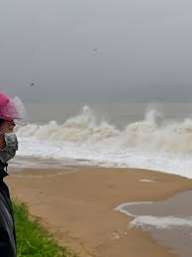
Typhoon Kalmaegi made landfall in central Vietnam on Thursday, days after killing at least 140 people and leaving 127 others missing in the Philippines.
The powerful storm, which brought widespread destruction across the central Philippines earlier in the week, hit Vietnam’s coast with sustained winds of up to 149 kilometres per hour and stronger gusts, according to the country’s environment ministry.
Thousands of residents were evacuated from coastal areas in Vietnam’s Gia Lai and Quang Ngai provinces as authorities warned of life-threatening winds and flooding. “The wind is so strong, nothing can resist,” said Vu Van Hao, a 48-year-old hotel worker in Gia Lai, describing shattered windows and damaged buildings.
Provincial official Pham Anh Tuan described Kalmaegi as “a huge typhoon with terrible devastating capacity.” State media reported that over 7,000 people had been evacuated from high-risk areas as the storm approached. Schools were shut in affected provinces, while at least five airports were closed and dozens of flights cancelled or diverted.
Before the typhoon’s landfall, Vietnamese President To Lam suspended a Communist Party central committee meeting to allow officials to return to their home regions and coordinate emergency response efforts.
Meanwhile, the Philippines continues to grapple with the aftermath of the storm. Kalmaegi swept through Cebu and Negros islands earlier in the week, triggering massive floods that displaced over 500,000 people and caused extensive damage to homes and infrastructure.
Floodwaters described as unprecedented submerged towns and cities, sweeping away vehicles and houses. In Liloan, near Cebu City, 35 bodies were recovered as residents struggled to clear debris and mud.
Philippine President Ferdinand Marcos declared a “state of national calamity” on Thursday, enabling the government to release emergency funds and control prices of essential goods.
Vietnam, one of the world’s most disaster-prone nations, experiences around ten typhoons annually. However, Kalmaegi is the 13th storm to hit the country in 2025. Officials warn that heavy rains could worsen existing flooding from the past week, which has already killed at least 47 people and submerged UNESCO heritage sites in Hue and Hoi An.
Experts link the increasing intensity and frequency of storms in the region to human-driven climate change, which is amplifying extreme weather events across Southeast Asia.
According to Vietnam’s national statistics office, natural disasters have killed or left 279 people missing so far this year, causing an estimated $2 billion in damages.