

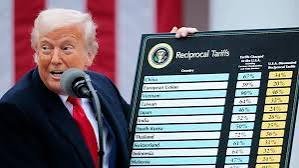
A sweeping new wave of tariffs imposed by President Donald Trump officially took effect at midnight, targeting imports from more than 90 countries in what the administration describes as a bold overhaul of the global trade system.
“IT’S MIDNIGHT!!! BILLIONS OF DOLLARS IN TARIFFS ARE NOW FLOWING INTO THE UNITED STATES OF AMERICA!” Trump announced on his social media platform just before the deadline, underscoring the significance of the move.
The latest tariffs include a 50% duty on goods from India, scheduled to be enforced from August 27 unless New Delhi halts its purchases of Russian oil—a condition widely interpreted as part of Washington’s broader effort to economically isolate Moscow.
Trump has also threatened a 100% tariff on foreign-manufactured computer chips, a move aimed at pushing tech companies to shift production to the United States. The strategy appears to be having some effect, with Apple recently announcing a $100 billion domestic investment, reportedly following sustained White House pressure.
Last week, the administration released an updated list of revised import taxes and gave countries until August 7 to negotiate terms or face the new penalties. The president has defended the measures as “reciprocal,” aimed at correcting what he calls a long-standing imbalance that has hurt American businesses and workers.
Southeast Asian nations with heavy export reliance were among the hardest hit. Myanmar and Laos now face tariffs of up to 40%, a move analysts interpret as part of an indirect strategy to pressure China by targeting its regional partners.
Despite the sweeping measures, reaction in Asian stock markets was mixed on Thursday. Indices in Japan, Hong Kong, South Korea, and China saw modest gains, while India and Australia posted slight losses.
“This is supposed to be it. Now you can start to analyse the impact of the tariffs,” said Bert Hofman, an economist at the National University of Singapore. He noted that the new rules provide clarity for countries to begin adjusting their trade strategies.
Some U.S. allies were able to negotiate reduced tariffs in last-minute talks. The UK, Japan, and South Korea secured more favorable terms, while the European Union reached a framework agreement accepting a 15% tariff on its exports.
Taiwan, a key U.S. partner in the Indo-Pacific region, was hit with a 20% tariff. President Lai Ching-te called the measure “temporary,” noting that discussions with Washington are ongoing.
Canada’s tariff rate jumped from 25% to 35% after Trump accused the country of not doing enough to curb the flow of fentanyl and other narcotics into the U.S. Canadian officials rejected the accusation, stating they are ramping up efforts to combat cross-border drug trafficking. However, the impact on Canadian exports may be limited due to protections under the United States-Mexico-Canada Agreement (USMCA).
Tariffs on Mexican goods have been delayed for 90 days as the two countries continue negotiations on a new bilateral trade framework.
Trump’s aggressive tariff strategy represents a significant gamble aimed at reshaping the global trade landscape. Supporters argue the move could strengthen domestic industries and restore fairness to trade, while critics warn it risks triggering retaliation, increasing consumer prices, and straining international relations.
For now, the administration is relying on economic pressure and uncertainty to extract concessions—betting that a harder line will ultimately lead to better deals for the United States.