

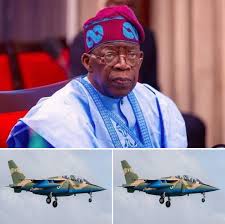
…projects aviation revenue to reach $2.58bn by 2029
President Bola Ahmed Tinubu says the Federal Government is working toward commencing the production of aircraft components in Nigeria as part of efforts to establish the country as the aviation hub of West and Central Africa.
Speaking at the Nigerian International Airshow in Abuja on Tuesday, Tinubu—represented by the Secretary to the Government of the Federation, George Akume—described the event as a major step that places Nigeria among countries hosting globally recognised aviation exhibitions such as Farnborough, Paris, and Dubai.
He said Nigeria’s aviation industry has grown significantly, with passenger traffic rising to 15.89 million in 2023 and expected to reach 25.7 million by 2029. The sector’s annual revenue is also projected to hit $2.58 billion within the same period.
Tinubu noted that the government is investing heavily in infrastructure upgrades, including a ₦712 billion refurbishment of the Murtala Muhammed Airport in Lagos, as well as improvements across six major airports and several runways nationwide.
According to him, Nigeria is now ranked first in Africa for compliance with international aviation standards, after raising its Cape Town Convention compliance score from 49.5 per cent to 75.5 per cent. He said this progress has boosted confidence among investors and allowed local airlines to access more affordable aircraft financing.
Tinubu announced that Nigeria has signed agreements with Boeing and Cranfield University for the establishment of advanced Maintenance, Repair and Overhaul (MRO) facilities, a development expected to reduce the over $200 million spent annually on foreign aircraft maintenance. He identified Aero Contractors and XEJet as early industry drivers, with new hubs emerging in Lagos and Abuja.
The President also highlighted recent gains in international routes, including Air Peace’s resumed Lagos–London flight, new Bilateral Air Service Agreements, and the return of Emirates and Uganda Airlines to the Nigerian market. He added that aviation now contributes 2.5 per cent to Nigeria’s GDP.
Tinubu reaffirmed that Nigeria is building a robust aviation ecosystem supported by public-private partnerships, expanded training centres, and preparations for local aircraft component production.
In a foreword for the Airshow’s inaugural magazine, Minister of Aviation and Aerospace Development, Festus Keyamo, described the event as historic, saying it marks Nigeria’s formal entry into the global aviation exhibition space. He noted improvements in safety, security, airport modernisation, aircraft leasing frameworks, and airspace digitalisation.
Keyamo said the government plans to deepen private-sector participation through concessions and partnership-driven projects, including maintenance facilities, cargo terminals, and aviation cities.
“This Airshow is more than an event; it is a statement of intent and a bold declaration that Nigeria is ready to lead, innovate, and compete on the global stage,” he said.