

Taiwan’s Defence Minister, Wellington Koo, has announced that the country’s newly introduced “T-Dome” air defence system is designed to create a fully integrated “sensor-to-shooter” network capable of delivering faster and more precise responses to enemy threats.
Speaking to reporters at parliament on Monday, Koo said the initiative would link Taiwan’s detection and interception systems for improved coordination and efficiency.
“If you achieve true integration, the probability of successful interception naturally increases,” he explained. “It allows for more efficient firepower coordination and better resource allocation.”
Unveiled by President Lai Ching-te during Taiwan’s National Day celebrations on Friday, the “T-Dome” forms a key pillar of the island’s defence modernisation strategy, which seeks to strengthen deterrence against China. Beijing claims Taiwan as part of its territory and has ramped up military and political pressure in recent years.
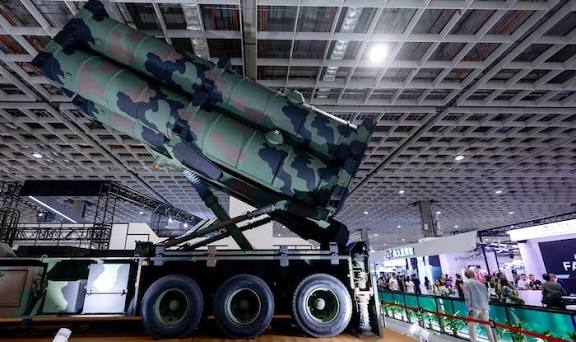
Koo revealed that a special budget outlining expenditure on new “T-Dome” equipment will be submitted before the end of the year. He said priority will be given to systems that emphasise mobility, high survivability, and integration, combining anti-aircraft, anti-missile, and anti-drone capabilities.
Taiwan’s current air defence arsenal includes U.S.-made Patriot missiles, domestically developed Sky Bow systems, and Stinger missiles for low-level threats. The island is also working on the Chiang-Kong missile, designed for high-altitude interception.
According to Koo, the “T-Dome” aligns with Taiwan’s asymmetric warfare strategy, which aims to make its smaller military more agile and capable of delivering precision strikes. The approach mirrors the U.S. military’s Combined Joint All-Domain Command and Control (CJADC2) framework, integrating sensors and weapons across multiple domains into a unified network.
President Lai, who has repeatedly rejected Beijing’s sovereignty claims, has pledged to raise defence spending to 5% of GDP by 2030, reaffirming Taiwan’s commitment to self-defence amid China’s expanding military presence.
While China continues to advance its arsenal of stealth fighters and aircraft carriers, its military faces internal challenges, including an ongoing anti-corruption campaign targeting senior officers.
Taiwanese officials described the “T-Dome” as both a technological milestone and a strategic necessity in an increasingly volatile Indo-Pacific security environment.