


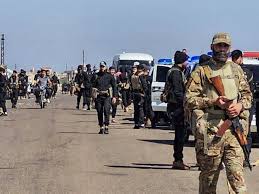
At least 30 people have been killed and more than 100 injured in fierce clashes between Bedouin Sunni tribes and members of the Druze minority in southern Syria, in what is being described as one of the deadliest outbreaks of sectarian violence since the fall of the Assad regime in December.
The fighting erupted in the city of Sweida, a predominantly Druze region, prompting a swift intervention by Syrian security forces dispatched by the Islamic-led transitional government. The Syrian Interior Ministry confirmed 30 fatalities, while the UK-based Syrian Observatory for Human Rights reported at least 37 deaths, citing local medical sources and eyewitness accounts.
This latest violence comes amid ongoing instability following the collapse of President Bashar al-Assad’s regime, which ended the Assad family’s five-decade rule. The government was overthrown in late 2024 when Sunni Islamist rebels, led by Hayat Tahrir al-Sham (HTS), seized control of Damascus. Since then, the interim government has struggled to maintain authority over a deeply fragmented nation rife with ethnic and sectarian divisions.
Sweida’s Governor, Mustapha al-Bakur, made a televised appeal on Monday calling for calm and urging citizens to support the country’s fragile reform process. Prominent Druze religious leaders also issued public statements pleading for restraint, warning of the potential for further bloodshed if tensions continue to escalate.
Sectarian strife involving the Druze is not unprecedented. Deadly confrontations between Druze militias and government-aligned forces were recorded in April and May. The Druze, a small esoteric religious group rooted in Shia Islam, had largely supported the Assad regime during Syria’s 13-year civil war, viewing it as a buffer against extremism and persecution. With Assad ousted, the community now faces heightened vulnerability under a Sunni-majority administration they perceive as unsympathetic to minority rights.
Speaking to the BBC earlier this month, Druze residents expressed deep fears of both physical violence and political marginalization in the new political landscape. Similar fears are being echoed by other minority groups across Syria. The Alawite community, historically aligned with Assad, has suffered significant losses in recent months, while Christian communities remain on edge following an attack on a church in Damascus.
The renewed unrest adds pressure to the international community as it cautiously re-engages with post-Assad Syria. In a notable shift, the United States recently delisted HTS as a foreign terrorist organization—a move interpreted as a step toward limited diplomatic engagement. Earlier this month, UK Foreign Secretary David Lammy became the first British official to visit Syria since the civil uprising began in 2011.
Observers warn that unless sectarian tensions are addressed and inclusive governance structures are established, Syria risks sliding deeper into a new phase of internal conflict—this time between the very factions that had once united to end Assad’s rule.