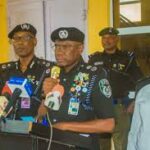


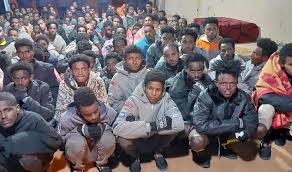
Libyan authorities have rescued more than 100 migrants, including five women, from captivity in the eastern town of Ajdabiya, where they were being held for ransom by a human trafficking network, the country’s attorney general announced on Monday.
In a statement, the attorney general’s office said the migrants had been unlawfully detained, tortured, and extorted by a gang that demanded ransoms from their families in exchange for their release. The criminal group was also involved in smuggling activities.
Ajdabiya, located roughly 160 kilometres southwest of Benghazi, served as the site of the gang’s operations. Five suspected traffickers — citizens of Libya, Sudan, and Egypt — have been arrested in connection with the case.
Photographic evidence retrieved from the suspects’ mobile phones and published by the attorney general and the local security directorate showed victims bound at the hands and feet, with visible signs of abuse.
Libya continues to serve as a key route for migrants fleeing conflict and poverty in Africa and the Middle East, hoping to reach Europe. The flow of migrants surged following the 2011 NATO-backed uprising that toppled longtime ruler Muammar Gaddafi, leaving the country fragmented and vulnerable to armed groups and trafficking networks.
The rescue operation follows a series of grim discoveries. In February, at least 28 bodies were found in a mass grave near Kufra, believed to be migrants tortured and killed by traffickers. A similar incident occurred earlier with 19 bodies uncovered in the Jikharra region, linked to a known smuggling network.
According to the United Nations, as of December 2024, Libya was hosting around 825,000 migrants from 47 countries.
Efforts to tackle the crisis continue. Just last week, the European Union’s migration commissioner, along with ministers from Italy, Malta, and Greece, held talks with Libya’s Prime Minister Abdulhamid Dbeibah to address the rising tide of illegal migration and human trafficking.