

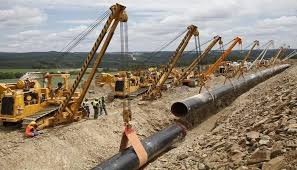
The Nigerian National Petroleum Company Limited (NNPC) has announced that the 614-kilometre Ajaokuta-Kaduna-Kano (AKK) gas pipeline project is now 86.05 per cent complete, with mechanical completion projected for the end of November 2025.
The AKK project, valued at approximately $2.8 billion, had previously suffered multiple delays, having been initially slated for completion in December 2023, before being pushed to the fourth quarter of 2024, and later to the first quarter of 2025.
Mechanical completion refers to the phase in large-scale engineering projects when all mechanical works—including installation, welding, and piping—are fully completed and the system is ready for testing or commissioning.
Speaking at the “2025 AKK Pipeline Progress Update and Opportunities Engagement” held in Abuja on Thursday, NNPC’s Group Chief Executive Officer, Bayo Ojulari, described the project as a transformative infrastructure initiative with immense economic, industrial, and energy significance for Nigeria.
Ojulari said the AKK pipeline would transport up to 2.2 billion standard cubic feet of gas daily to power plants and industries in Abuja, Kaduna, Kano, and surrounding areas. According to him, the project will reignite industrial activities in northern Nigeria, create thousands of jobs, and boost national integration.
“This is more than a pipeline—it is a catalyst for industrial revival and economic expansion,” Ojulari stated, adding that over 1,900 Nigerians have already been employed on the project, with thousands more expected to benefit from its ripple effects.
He also highlighted plans to develop industrial parks in Ajaokuta, Kano, and other areas along the pipeline corridor, promising that these will generate tax revenues, employment, and investment opportunities.
In terms of national energy strategy, Ojulari noted that the AKK pipeline is aligned with Nigeria’s ‘Decade of Gas’ initiative, aimed at reducing dependence on oil and promoting gas as a cleaner, more sustainable energy source. He said the project will also support compressed natural gas (CNG) adoption for transportation, reduce emissions, and enhance the movement of goods and agricultural produce across the country and sub-Saharan Africa.
The Executive Director of Projects at the Nigeria Gas Infrastructure Company Limited (NGIC), Audu Ibrahim, confirmed that key milestones—such as the River Niger crossing and welding of the second segment of the pipeline—have been completed. He reiterated that full mechanical completion is expected by November 30, 2025.
“The pipeline from KP303 to Kano is fully welded, tested, and ready to receive gas. With the River Niger crossing completed, we now have a clear pathway to final delivery,” Ibrahim said.
He listed security threats, challenging terrain, COVID-19 disruptions, and financing difficulties as some of the hurdles the project faced. However, he noted that NNPC’s restructuring under the Petroleum Industry Act (PIA) has improved its capacity to independently raise funds.
Also speaking, NNPC’s Executive Vice President of Gas, Power, and New Energy, Olalekan Ogunleye, said that under the PIA, the company now operates like a commercial entity and can easily access capital markets to fund bankable projects.
“Funding, which used to be a challenge, is no longer a major concern. With our enhanced corporate structure and project credentials, we now have the flexibility to attract financing globally,” Ogunleye noted.
The AKK pipeline is expected to be fully operational by 2026, with terminal gas and intermediate stations scheduled for completion shortly after mechanical handover.