

Governor Peter Mbah of Enugu State has officially defected from the Peoples Democratic Party (PDP) to the ruling All Progressives Congress (APC), marking a significant political shift in the South-East.
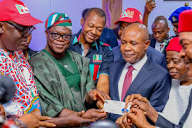
The APC National Working Committee (NWC) on Tuesday formally presented Mbah with the party’s membership card at the Government House, Enugu. The governor was joined in the defection by all state commissioners, the 17 local government chairpersons, all councillors, and more than 80 percent of PDP executives in the state.
Speaking during the event, Mbah said the decision followed “long reflection” and was aimed at aligning Enugu with the federal government. “This move is bigger than politics—it is about connecting Enugu’s destiny to the central hub of national reforms,” he stated, while commending President Bola Tinubu’s commitment to South-East development.
He described his defection as a “visionary partnership” with the Tinubu administration, saying his government shares the president’s belief in bold, inclusive development. “Renewal must reach the ward, the village, and the grassroots where the farmer, trader, and young entrepreneur live,” Mbah said.
The ceremony was attended by the state’s immediate past governor, Ifeanyi Ugwuanyi, though it remained unclear whether he also joined the APC.
With this defection, the APC now controls Enugu State—previously a PDP stronghold since 1999—leaving the South-East with two APC states, Imo and Ebonyi. Anambra remains under the All Progressives Grand Alliance (APGA), while Abia is governed by the Labour Party.
Mbah’s defection follows internal crises within the PDP over the party’s national secretary position, which created a prolonged rift between the South-East leadership and the national working committee. The tension deepened after the Supreme Court reinstated Samuel Anyanwu as national secretary earlier in 2025, a decision opposed by the zone’s PDP leaders who backed Sunday Udeh-Okoye. Udeh-Okoye resigned from the PDP on Monday, a day before Mbah’s official defection.