


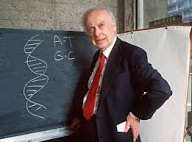
James Watson, the American biologist who co-discovered the structure of DNA and won a Nobel Prize for the groundbreaking discovery, has died at the age of 97.
The Cold Spring Harbor Laboratory in New York, where he spent much of his career, announced on Friday that Watson passed away in hospice care on Long Island.
Watson was best known for his role in the 1953 discovery of DNA’s double-helix structure, made alongside Francis Crick. Their work, published in Nature, revolutionized biology by explaining how genetic information is stored and transmitted, laying the foundation for modern genetics, biotechnology, and DNA-based forensics.
In 1962, Watson shared the Nobel Prize in Physiology or Medicine with Crick and Maurice Wilkins for their discovery, which became one of the most significant scientific achievements of the 20th century.
Born on April 6, 1928, in Chicago, Watson showed early academic brilliance, earning a scholarship to the University of Chicago at age 15 and a Ph.D. in zoology from Indiana University in 1950. His time at Cambridge University led to his partnership with Crick, where they used X-ray diffraction data — including crucial images captured by Rosalind Franklin — to model DNA’s now-famous double-helix shape.
Watson’s 1968 memoir, The Double Helix, offered a candid, and at times controversial, account of the race to uncover DNA’s structure. While it became a bestseller, it drew criticism for his dismissive portrayal of Franklin, whose contributions were essential but went unrecognized by the Nobel Committee, as the prize is not awarded posthumously.
Despite his scientific brilliance, Watson’s later years were overshadowed by controversy. In 2007, he faced global condemnation after claiming in an interview that people of African descent were less intelligent than others — remarks widely condemned as racist. Although he apologized, the Cold Spring Harbor Laboratory removed him from his chancellor role and later revoked his emeritus status after he repeated similar comments in a 2019 PBS documentary.
Watson served as director of Cold Spring Harbor Laboratory for 15 years, transforming it into a leading center for molecular biology research. He also helped launch the Human Genome Project in 1988, overseeing efforts to map the human genetic code.
He is survived by his wife, Elizabeth, and their two sons, Rufus and Duncan.
Cold Spring Harbor Laboratory, while acknowledging its past separation from Watson, praised his “extraordinary contributions” to science, noting that his discovery fundamentally changed humanity’s understanding of life.