

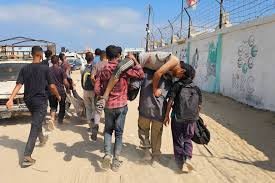
At least 36 Palestinians were shot dead by Israeli forces at dawn on Saturday while approaching an aid distribution point in Gaza, according to the Gaza Health Ministry and Nasser Hospital in Khan Younis. Several others remain wounded or missing in what is the latest deadly incident surrounding humanitarian aid deliveries in the enclave.
The Israeli military confirmed opening fire, claiming it had issued verbal warnings and fired warning shots at individuals who approached its forces near an inactive aid site. According to the military, the group did not respond and was approximately a kilometre away from the facility.
However, eyewitnesses challenge that account. Mohammed al-Khalidi, a Gaza resident present at the scene, described chaos and panic as Israeli forces opened fire. “We thought they came to organise us to get aid,” he said. “Suddenly, jeeps came from one side, tanks from the other, and they started shooting at us.”
The Gaza Humanitarian Foundation (GHF), the organisation overseeing the aid site, stated that the deadly shooting occurred hours before its distribution point opened. “There were no incidents or fatalities at our site on Saturday,” GHF said, reiterating its public advisory against travelling to aid sites in the dark. “Most of the casualties occurred several kilometres away from the nearest GHF location.”
The Israeli military has launched a review of the incident, which adds to growing scrutiny over the conduct of its operations in civilian zones during the ongoing conflict.
GHF, which operates independently of the United Nations’ aid system and contracts private American logistics and security firms, has been at the center of controversy. Israeli officials have accused Hamas of diverting aid from international convoys, an allegation the group denies. Meanwhile, the UN has criticised GHF’s methods as unsafe and inconsistent with humanitarian neutrality—claims GHF rejects.
According to the UN human rights office in Geneva, at least 875 people have been killed near aid convoys and food distribution sites in Gaza over the past six weeks. Many of the incidents occurred near GHF-run locations and, according to local witnesses, were attributed to Israeli fire. The Israeli military has acknowledged civilian casualties in those areas and said it has revised its operational protocols.
In other parts of Gaza, health officials reported at least 50 more fatalities from Israeli airstrikes on Saturday. Among those killed were the Hamas-run police chief in Nuseirat and 11 members of his family. The Israeli military said the strikes targeted militant weapons caches and sniper positions.
The conflict, which began on October 7, 2023, after Hamas-led militants killed around 1,200 people in Israel and took 251 hostages, has escalated into a full-scale military campaign. According to Gaza health authorities, nearly 58,000 Palestinians—mostly civilians—have been killed since, with nearly the entire population displaced.
In Doha, negotiations are ongoing between Israel and Hamas, mediated by Egypt and Qatar, to secure a U.S.-backed 60-day ceasefire and a new hostage exchange deal. However, progress remains elusive.
Of the 50 remaining hostages in Gaza, at least 20 are believed to be alive. Speaking outside Israel’s Defence Ministry headquarters in Tel Aviv, Einav Zangauker—whose son Matan is among those held—pleaded for immediate action.
“An entire people wants to bring all 50 hostages home and end the war,” she said. “My Matan is alone in the tunnels. He has no more time.”