


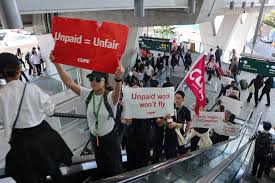
Air Canada’s operations remained paralysed on Sunday after striking flight attendants refused to comply with a government-backed order to return to work, escalating a major standoff between the airline, the Canadian government, and its largest flight attendants’ union.
The Canadian Union of Public Employees (CUPE), representing 10,000 cabin crew, rejected a directive from the Canada Industrial Relations Board (CIRB) to enter binding arbitration, arguing it stripped workers of bargaining power and violated constitutional rights. CUPE instead called on Air Canada to resume negotiations for what it described as a “fair deal.”
The defiance left hundreds of planes grounded and disrupted travel for many of the 130,000 passengers the carrier serves daily as part of the Star Alliance network. Air Canada said it would postpone efforts to restart flights until Sunday evening and accused the union of “illegally defying” the CIRB’s order.
Central to the dispute are wages and the industry practice of only paying flight attendants while aircraft are airborne. CUPE insists attendants should also be compensated for essential ground duties such as passenger boarding. The demand echoes recent labour victories in the United States, where airlines including American and Alaska have agreed to pay cabin crew during boarding, while United Airlines attendants rejected a deal in July partly over the same issue.
Prime Minister Mark Carney’s Liberal government last week sought to end the strike by invoking Section 107 powers through the CIRB to impose arbitration, a move unions rarely defy. While previous governments, including Justin Trudeau’s, used similar measures to prevent rail and dock strikes, CUPE described its resistance as “unprecedented.”
The government has yet to announce its next steps, though options include court enforcement of the order or introducing back-to-work legislation when Parliament reconvenes on September 15. Analysts caution that Ottawa must act carefully, as the Supreme Court of Canada has warned against heavy-handed interventions that erode the constitutional right to strike.
“The government will be very reticent to be too heavy-handed,” said Dionne Pohler, professor of dispute resolution at Cornell University. “Another option is to encourage bargaining.”
At Toronto Pearson International Airport, stranded travellers expressed mixed feelings. “They are right,” said Francesca Tondini, a 50-year-old Italian passenger. “I support them, even though I don’t know when I’ll be able to return home.”
With both sides refusing to back down, uncertainty persists over when Air Canada will resume normal operations, marking one of the country’s most disruptive labour disputes in recent years.