

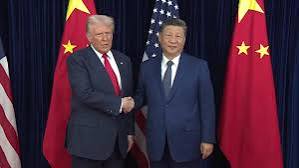
U.S. President Donald Trump has directed the Pentagon to resume nuclear weapons testing, placing the United States on par with China and Russia in nuclear capabilities. The announcement came Thursday, moments before Trump’s high-profile meeting with Chinese President Xi Jinping in South Korea.
Trump’s declaration followed Russian President Vladimir Putin’s claim a day earlier that Moscow had successfully tested a nuclear-capable, nuclear-powered underwater drone, in defiance of U.S. warnings.
“Because of other countries’ testing programs, I have instructed the Department of War to start testing our nuclear weapons on an equal basis,” Trump stated on social media, citing both Russia and China.
The U.S. leader boasted that the country possesses the largest nuclear arsenal globally, crediting his administration for a “complete update and renovation” of existing weapons. “Russia is second, and China is a distant third, but will be even within five years,” he added.
According to the International Campaign to Abolish Nuclear Weapons (ICAN), nine countries currently possess nuclear arms the United States, Russia, China, France, the United Kingdom, Pakistan, India, Israel, and North Korea. ICAN estimates that Russia holds about 5,580 of the world’s 12,331 nuclear warheads, while the United States possesses 5,044.
Trump did not specify what type of testing would be conducted but said the process would “begin immediately.”
Putin, in televised remarks from a Russian military hospital, described the new underwater drone, codenamed Poseidon, as “impossible to intercept.” He said the weapon could travel faster than submarines, dive deeper, and reach any continent.
The Russian leader’s announcement marked the second nuclear weapons test in days. On Sunday, Russia tested a new cruise missile a move Trump criticized, urging Putin to “end the war in Ukraine instead of testing missiles.”
The United States last conducted a nuclear test in September 1992 at the Nevada Nuclear Security Site. Then-President George H.W. Bush imposed a moratorium the following month, which was upheld by subsequent administrations. Since then, the U.S. has relied on computer simulations and subcritical experiments instead of full-scale nuclear detonations.
Trump’s renewed testing directive is expected to heighten global security concerns as he meets Xi Jinping their first face-to-face engagement since Trump’s re-election amid escalating competition among the world’s top three nuclear powers.