

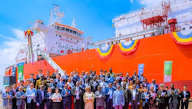
The Nigerian National Petroleum Company Limited (NNPCL), in partnership with Sahara Group, Eroton E&P, and Bilton Energy Ltd, has commissioned Nigeria’s first wholly-owned Floating Storage and Offloading (FSO) vessel — a 2.2 million-barrel capacity terminal named Cawthorne. The milestone marks the country’s first crude oil terminal to be inaugurated in 50 years.
Announcing the development in a statement on Wednesday, Sahara Group’s Chief Corporate Communications Officer, Mr. Bethel Obioma, said the world-class facility was designed to enhance crude evacuation from Oil Mining Lease (OML) 18 and neighbouring assets.
Speaking at the commissioning, NNPC Executive Vice President (Upstream), Udobong Ntia, who represented the Group Chief Executive Officer, Bayo Ojulari, said the project was “a bold achievement” that supports President Bola Tinubu’s target of optimising upstream oil production.
Strategically positioned offshore Bonny, the double-hull FSO Cawthorne — with a capacity of 2.2 million barrels — is expected to boost Nigeria’s crude export infrastructure and address long-standing logistical bottlenecks. The facility will receive, store, and offload crude oil to export tankers, reducing dependence on pipelines and the risks associated with oil theft and vandalism.
Cutting the ribbon to officially commission the vessel, NNPC Chief Upstream Investment Officer, Seyi Omotola, described the project as a “renewed hope” for Nigeria’s energy sector and proof of its growing global competitiveness.
Executive Commissioner, Development & Production, Nigerian Upstream Petroleum Regulatory Commission (NUPRC), Enorense Amadasu, who represented Chief Executive Gbenga Komolafe, said the FSO aligned with NUPRC’s vision of promoting reliable and sustainable production growth.
According to Niger Delta Exploration and Production Offshore Ltd Managing Director, Ibiyemi Asaolu, the project demonstrates the power of “innovation, collaboration, and execution excellence,” while ensuring production continuity from OML 18 and contributing to Nigeria’s energy stability.
Dr. Tosin Etomi, Head of Commercial and Planning at Asharami Energy (a Sahara Group upstream subsidiary), described the Cawthorne as “a vessel built for the future,” integrating digital and AI-driven systems for operational flexibility, reduced carbon emissions, and improved safety.
The partners said the conversion of the Cawthorne from a Very Large Crude Carrier (VLCC) to a fully integrated FSO unit was a feat of engineering innovation — equipped with advanced mooring systems, import/export infrastructure, and compliance with international maritime and environmental standards.
Beyond immediate benefits, the FSO can accommodate up to 50 crew members and is designed as a scalable platform capable of supporting future production increases and tie-ins from other oil fields, underscoring its role as a strategic national asset.