

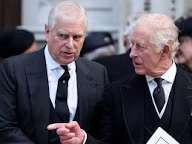
Britain’s King Charles III has formally stripped his younger brother, Prince Andrew, of his royal title and ordered him to vacate his residence at the Royal Lodge in Windsor, Buckingham Palace announced on Thursday. The move marks the strongest step yet by the monarch to distance the royal family from the lingering scandal surrounding Andrew’s association with the late sex offender Jeffrey Epstein.
According to a Reuters report, Andrew, 65, will now be known simply as Andrew Mountbatten-Windsor, following the withdrawal of all remaining titles and privileges. Earlier this month, he was directed to cease using the title Duke of York, a position he had held since 1986.
The palace confirmed that a formal notice had been issued for Andrew to surrender the lease of his Windsor residence, with arrangements being made for him to relocate to alternative private accommodation on the Sandringham estate in eastern England.
“These censures are deemed necessary, notwithstanding the fact that he continues to deny the allegations against him,” the palace stated. “Their Majesties wish to make clear that their thoughts and utmost sympathies have been, and will remain with, the victims and survivors of any and all forms of abuse.”
The decision, taken as King Charles continues treatment for cancer, represents one of the most consequential disciplinary actions within the British monarchy in decades. Palace sources said the king acted with the full backing of the royal family, including Prince William, the heir to the throne.
Once celebrated as a decorated naval officer who served in the Falklands War, Andrew’s public standing collapsed amid scrutiny of his relationship with Epstein. He relinquished his role as the UK’s trade envoy in 2011, withdrew from royal duties in 2019, and was stripped of military titles and royal patronages in 2022.
That same year, he settled a lawsuit filed by Virginia Giuffre, who accused him of sexually abusing her when she was a minor — claims he has consistently denied. The controversy resurfaced recently following the publication of Giuffre’s memoir, in which she detailed her encounters with Andrew.
Earlier this month, British newspapers The Mail on Sunday and The Sun published 2011 correspondence between Andrew and Epstein, in which the prince expressed a desire to “keep in close touch” and “play some more soon,” further intensifying public backlash.
Palace insiders cited “serious lapses of judgment” as justification for the king’s decision. Reports also revealed that Andrew had not paid rent for his 30-room Royal Lodge mansion for nearly two decades, having initially covered renovation costs.
The development came a day after a parliamentary committee questioned whether Andrew should still occupy the publicly owned residence.
Analysts say King Charles’s decision underscores his determination to safeguard the monarchy’s credibility amid declining support from younger generations. Royal observers have compared the move to King Edward VIII’s abdication in 1936 another defining moment in the modern history of the British royal family.