

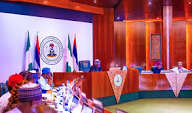
The Federal Executive Council (FEC) has approved Nigeria’s 2026–2028 Medium-Term Expenditure Framework (MTEF), setting out the country’s economic outlook, revenue projections, and spending priorities for the next three years.
Briefing journalists after Wednesday’s FEC meeting in Abuja, Minister of Budget and National Planning, Atiku Bagudu, said the oil price benchmark for 2026 is pegged at $64 per barrel, with an exchange rate assumption of ₦1,512 to the US dollar. While the council set an oil production target of 2.06 million barrels per day, fiscal planning is based on a cautious 1.8 million bpd.
Bagudu noted that the exchange rate projection reflects the pre-election year context and stems from detailed macroeconomic and fiscal analyses by the Budget Office and partner agencies. Inflation is projected to average 18 percent in 2026.
Revenue and Spending Projections
According to the minister, total revenue accruing to the federation in 2026 is estimated at ₦50.74 trillion, to be shared among federal, state, and local governments. The federal government is expected to receive ₦22.6 trillion, states ₦16.3 trillion, and local governments ₦11.85 trillion.
Including revenues from government-owned enterprises totaling ₦4.98 trillion, the total projected Federal Government revenue stands at ₦34.33 trillion—representing a 16 percent decline compared to the 2025 budget estimate. Statutory transfers are projected at roughly ₦3 trillion, while debt servicing is estimated at ₦10.91 trillion. Non-debt recurrent spending, covering personnel and overhead costs, is set at ₦15.27 trillion. The fiscal deficit is projected at ₦20.1 trillion, equivalent to 3.61 percent of GDP.
Economic Outlook
The MTEF projects nominal GDP to rise to over ₦690 trillion in 2026, climbing to ₦890.6 trillion by 2028, with a GDP growth rate of 4.6 percent in 2026. Non-oil GDP is expected to grow from ₦550.7 trillion in 2026 to ₦871.3 trillion in 2028, while oil GDP is estimated to increase from ₦557.4 trillion to ₦893.5 trillion over the same period.
Bagudu emphasized that the framework reflects prudent planning and aims to balance fiscal discipline with strategic investments to sustain economic growth and stability.