

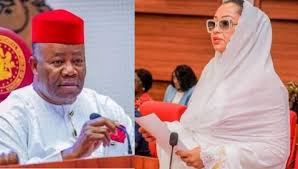
Senate President Godswill Akpabio has filed an appeal at the Court of Appeal in Abuja, seeking to overturn a Federal High Court judgment that nullified the suspension of Senator Natasha Akpoti-Uduaghan and ordered her recall to the Senate.
The appeal, dated July 14, 2025, stems from suit No. FHC/ABJ/CS/384/2025 filed by Akpoti-Uduaghan to challenge her six-month suspension from the Senate. Justice Binta Nyako had on July 4 ruled in her favour, describing the suspension as excessive and lacking legal justification.
Akpabio’s 11-ground appeal argues that the Federal High Court exceeded its constitutional authority by interfering in what he described as the internal affairs of the legislature. He contends that disciplinary measures such as suspensions fall exclusively within the Senate’s jurisdiction, protected by Section 251 of the 1999 Constitution and the Legislative Houses (Powers and Privileges) Act.
The Senate President faulted the court for dismissing his preliminary objection and maintained that Akpoti-Uduaghan should have first exhausted the Senate’s internal grievance mechanisms—specifically through the Committee on Ethics, Privileges and Public Petitions—before resorting to litigation.
He also argued that Akpoti-Uduaghan’s complaint arose from plenary proceedings, which are protected by law from judicial interference. His legal team accused the trial court of overreach, particularly for making pronouncements not directly argued by either party, including the declaration that her suspension was excessive and the directive for her recall.
Akpabio further alleged procedural irregularities, including the merging of interlocutory reliefs with substantive prayers, which he said compromised his right to a fair hearing. He also cited non-compliance with Section 21 of the Legislative Houses (Powers and Privileges) Act, which requires a three-month notice to the Clerk of the National Assembly before initiating a suit against the legislature. He argued that Akpoti-Uduaghan failed to fulfil this condition, thereby invalidating the court’s jurisdiction.
In his prayers before the Court of Appeal, Akpabio is seeking:
- An order setting aside the High Court’s dismissal of his preliminary objection
- A reversal of the ruling that the six-month suspension was excessive
- A nullification of the recommendation that Senator Akpoti-Uduaghan be recalled
- The striking out of duplicated reliefs in interlocutory and substantive motions
- Full dismissal of the suit for lack of jurisdiction
The appeal also criticized what it described as the lower court’s “advisory opinion” on how the Senate should conduct internal disciplinary proceedings, calling it a violation of legislative autonomy.
The case has reignited debate over the limits of judicial authority in legislative matters, particularly regarding the rights of lawmakers to seek redress from the courts in disciplinary cases.
Senator Akpoti-Uduaghan has yet to issue a formal response to the appeal. Legal analysts say the outcome of the case could set a significant precedent on the doctrine of separation of powers and the extent of legislative privilege in Nigeria’s constitutional framework.
As proceedings move to the Court of Appeal, the spotlight remains on whether the judiciary will uphold its earlier intervention or affirm the Senate’s claim to internal self-governance.